




Types of Foundation Issues in Arizona Homes
- Kaber Robinson
- May 30th, 2026
Quick answer: Arizona homes see six main types of foundation issues: heave from expansive clay, settlement in loose or collapsing soil, land subsidence and earth fissures, movement caused by plumbing leaks and irrigation, stem wall deterioration, and ordinary concrete shrinkage cracks that are not a foundation problem at all. They look similar from the inside, but they have different causes and different urgency. Telling them apart is the whole ballgame, because the wrong assumption sends people down the wrong road for years.
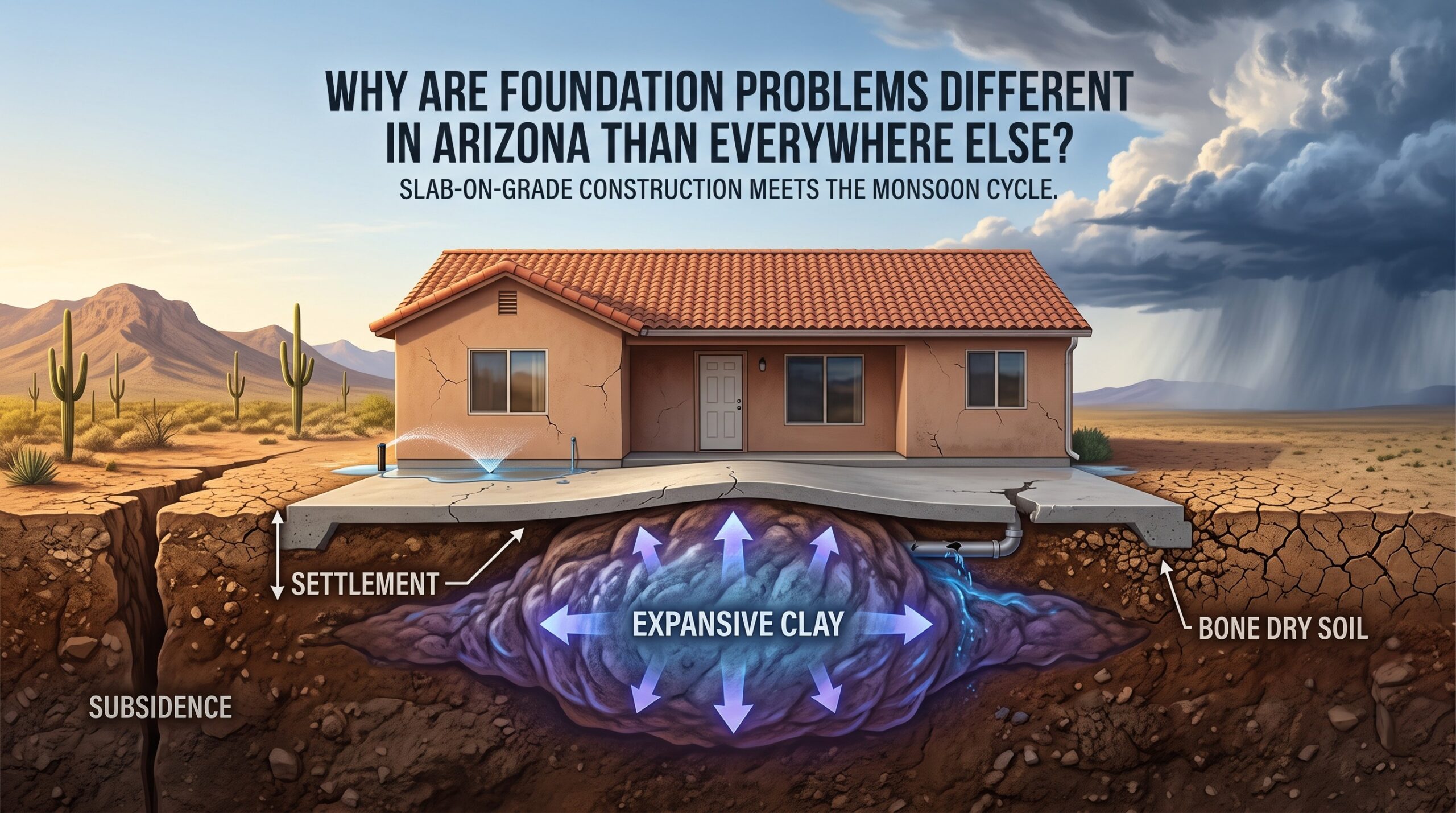
Why are foundation problems different in Arizona than everywhere else?
Almost every home here is built slab on grade. More than 95 percent of Arizona homes sit directly on a concrete slab with no basement, no sump, and usually no French drain, which means the soil is in direct contact with the floor you walk on. In most of the country a homeowner can go downstairs and look at the foundation. Here you cannot see it at all.
On top of that, the climate does something unusual to soil. The ground bakes bone dry for eight or nine months, then monsoon rain arrives all at once. That fast wetting and slow drying cycle, repeated year after year, is the engine behind most residential foundation movement in the Valley. Add decades of groundwater pumping across Maricopa and Pinal County and you get a second, slower problem happening underneath the first.
What are the main types of foundation issues in Arizona?
| Type | What is happening | Typical clue |
|---|---|---|
| Heave | Expansive clay swells upward as it takes on water | Center of the slab rises, doors bind at the top, damage worsens after summer rain |
| Settlement | Loose or undercompacted soil compresses or collapses when wetted | Corners and edges drop, gaps open where walls meet ceilings |
| Subsidence and fissures | Regional ground lowering from long term groundwater withddrawal | Long ground cracks near the property, distress across a whole area, not one house |
| Plumbing driven movement | A supply or drain leak saturates soil under one part of the slab | Localized damage, warm spot on the floor, unexplained water bill jump |
| Stem wall deterioration | Rebar inside the stem wall rusts and expands, breaking the concrete | Flaking or bulging stucco at the base of exterior walls |
| Shrinkage cracking | Concrete curing normally, not soil movement | Thin hairline cracks that never widen or change with the seasons |
Foundation heave: the most common Arizona problem
Expansive soil contains smectite clay, which swells to many times its volume when it gets wet and shrinks back down when it dries. The Arizona Geological Survey notes that roughly half of homes in the United States are built on expansive soils and nearly half of those see some damage from it, and that expansive soils cause more home damage every year in this country than floods, tornadoes, and hurricanes combined.
Heave pushes upward, usually strongest under the middle of the slab where moisture accumulates and cannot escape. Homeowners notice tile popping loose in a line, drywall cracks near the ceiling that keep reopening after being patched, and doors that stick in one season and swing fine in another. That seasonal come and go pattern is the single best clue you are dealing with clay rather than a construction defect. If it turns out to be heave, the modern approach is expansive soil mitigation, which addresses moisture under the slab rather than tearing the slab out.
Clay rich soil is common in Gilbert and Chandler, around Anthem and the north Valley, in parts of the growing West Valley, and up through Prescott, the Verde Valley, and Flagstaff. It is a patchwork, though. Two homes a mile apart can sit on completely different soil.
Settlement and collapsing soil: the opposite direction
Settlement is heave in reverse. Instead of swelling, the soil compresses under the weight of the home or collapses when it finally gets wet. Arizona has a specific version of this called hydrocompaction, where loose, dry, low density material deposited by wind or ephemeral streams suddenly loses volume once water reaches it. That soil can sit stable for decades and then drop in a single wet season.
Settlement damage tends to concentrate at corners and along edges. Gaps open where walls meet the ceiling, exterior cracks run in a stair step pattern through block or stucco, and the whole corner of a room may feel like it is tipping. Unlike heave, settlement usually does not reverse itself when the weather changes.
Land subsidence and earth fissures
This one is regional rather than residential. Long term groundwater withdrawal has caused measurable ground lowering across parts of Maricopa, Pinal, Cochise, and Pima counties, and where that lowering is uneven, the ground can tear open into earth fissures. The Arizona Geological Survey maps known fissures across the state, and buyers looking at land on the edges of the metro area are wise to check.
Subsidence is not something a homeowner fixes. What matters is knowing whether you are in an affected area, because it changes how you interpret everything else you are seeing.
Movement caused by plumbing leaks and landscaping
A pinhole leak in a copper line under the slab can dump water into clay for months before anyone notices. So can a drip system running six inches from the stem wall, a downspout emptying in the same spot every storm, or grade that slopes toward the house instead of away.
- Watch for an unexplained jump in the water bill
- Notice if one area of tile floor feels warm underfoot
- Look for a patch of yard that stays damp when nothing else is
- Check whether damage clusters near a bathroom, kitchen, or laundry wall
This category is worth ruling out early because it is often the cheapest thing on this list to correct, and because leaving it alone feeds whatever soil problem you already have.
Stem wall deterioration
This one gets misdiagnosed constantly. On many Valley homes built from the 1970s through the 1990s, rebar was placed too close to the outside face of the stem wall. Decades of irrigation splashing against that surface lets moisture reach the steel, the steel rusts, rust expands, and the concrete cracks and flakes off from the inside out. Homeowners see stucco bubbling and breaking loose at the base of the exterior wall and assume the foundation is failing.
It is a real repair and it should be addressed, but it is a concrete and steel problem, not a soil movement problem. The soil under the slab may be perfectly fine.
When is a crack not a foundation problem?
Concrete shrinks as it cures, and thin hairline cracks in a slab or a garage floor are normal. So are small cracks above door and window corners in a house settling into its first couple of years. The question is not whether a crack exists. It is whether the crack is changing.
Photograph every crack, date the photo, and put a pencil mark at each end. If the crack has not moved in six months and does not shift with the seasons, it is very likely cosmetic. If it reopens every summer after you patch it, something underneath is moving.
Does any of this connect to radon?
It can, and it is worth knowing since you are already thinking about what is under your slab. Cracks and openings in a foundation are pathways for soil gas, and radon is the soil gas that matters for health. Arizona data from roughly 7,000 homes since 1993 shows an average of 2.9 pCi/L, with 26 percent above the EPA action level of 4 pCi/L. Phoenix homes usually land between 1 and 4 pCi/L, though some reach 10 to 30.
The two problems also share engineering. A radon system uses sub slab depressurization to draw gas out from beneath the foundation and vent it above the roofline, and a soil moisture system uses the same suction principle to pull humid air instead. If you are having the slab looked at anyway, a radon test is a reasonable thing to fold in, and it matters especially during a home inspection when you have a short window to learn what you are buying.
What should you do if you think you have one of these?
Start by figuring out which type you are looking at, because that determines everything after. Document the damage with dated photos, note whether it changes seasonally, cut off any water sources near the foundation, and rule out a slab leak. If the pattern points to clay movement, we are happy to take a look and tell you honestly what we see. A free estimate costs nothing and sometimes the answer is that you do not need anything at all. If you would rather ask a few questions first, our FAQ page covers a lot of the common ones.
Frequently Asked Questions
How can I tell if my foundation problem is heave or settlement?
Heave pushes the middle of the slab up and usually gets worse after monsoon rain, then eases as the soil dries. Settlement pulls corners and edges down and generally does not reverse with the seasons. Watching the pattern across a full year tells you more than any single crack does.
Are foundation cracks normal in Arizona homes?
Some are. Thin hairline cracks from concrete curing and minor cracks above door corners in a newer home are common and usually harmless. The ones that matter are cracks that widen over time, reopen after being repaired, or come and go with the weather.
Does a post tension slab prevent foundation problems?
A post tension slab resists cracking far better than a plain slab with rebar, which is why it is close to standard across Maricopa and Pinal County. It does not stop the soil underneath from swelling or settling, so post tension homes can still experience heave and the damage that follows.
Should I stop watering near my foundation?
Cutting back irrigation against the stem wall is one of the few genuinely free things you can do, and it helps with both clay movement and stem wall deterioration. Move emitters away from the house, keep thirsty plants back a few feet, and make sure downspouts discharge well away from the foundation.
Do foundation issues have to be disclosed when selling a home in Arizona?
Known material defects generally need to be disclosed on the seller property disclosure statement, and foundation movement typically qualifies. If you are buying, ask directly whether any cracks have been repaired and request documentation of any prior work.

Bio:
Kaber Robinson, a second-generation radon mitigator and the founder of Arizona Radon, has accumulated 30 years of experience in the industry. A nationally certified radon measurement and mitigation professional, Kaber’s commitment to health and environmental sustainability led him to the radon field after graduating from a renowned technical college in Kansas.
Gaining invaluable experience with a leading radon mitigation company in the United States, he traveled extensively to install systems across various environments. Today, Kaber applies his extensive knowledge and practical skills at Arizona Radon, where he ensures that each project adheres to the strictest standards of quality and safety.