





Expansive Soil Mitigation Service in Phoenix, AZ
Foundation Heave Specialists
We install and repair moisture mitigation systems that stop expansive soil from cracking your foundation, and we do it for a fraction of what traditional foundation repair costs.
- Licensed, Certified & Trusted
- Up-Front Pricing
- Satisfaction Always Guaranteed

Expansive Soil Remediation and Mitigation Services in Arizona
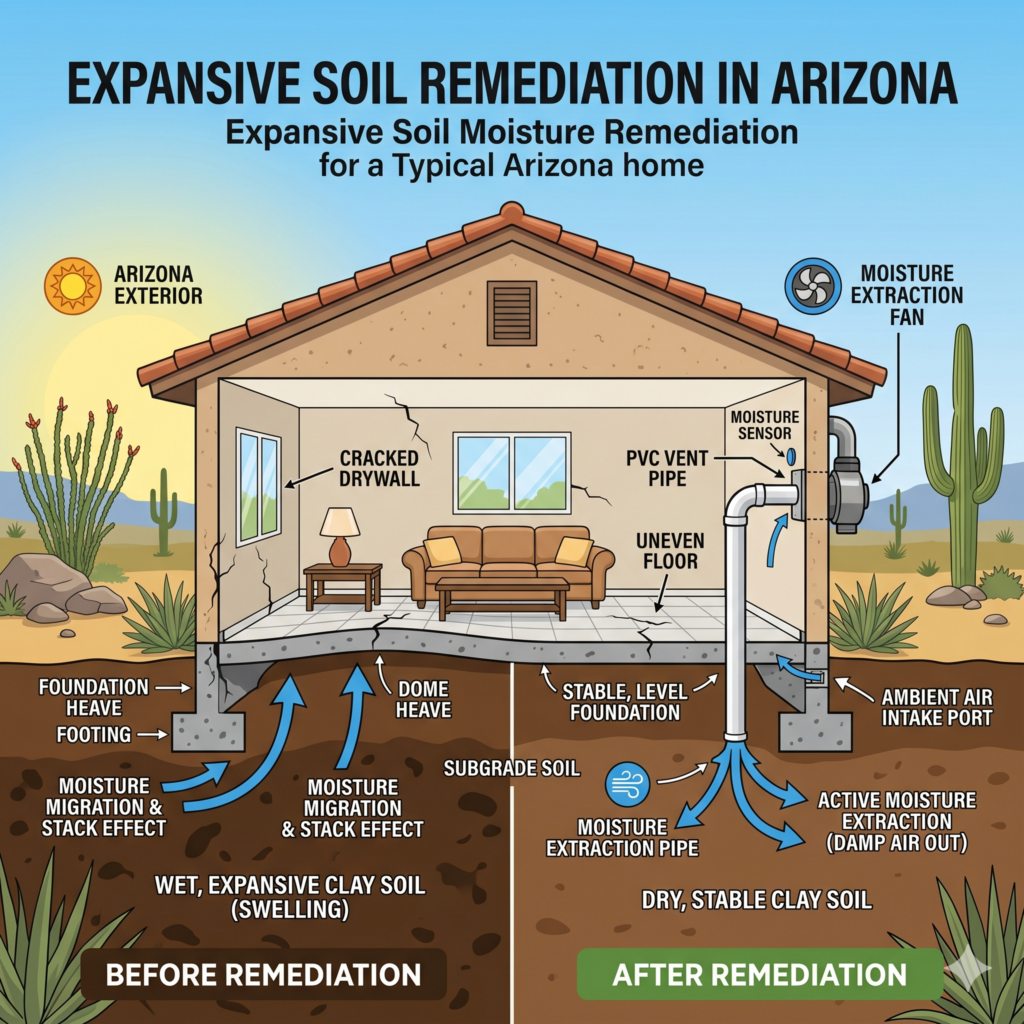
Arizona clay soils are tough on homes. When they soak up water they expand and push up against your concrete sub slab. When they dry out they shrink back down. Engineers call this dome heave, and it is one of the most common of the types of foundation issues in Arizona homes. The constant cycle of swelling and shrinking is what causes the cracked drywall, popping tile, and uneven floors that so many Arizona homeowners eventually find themselves dealing with.
At Arizona Radon we use the same proven sub slab depressurization science behind our radon mitigation work to solve this problem a different way. We install the MoistureLevel® Smart Foundation System, which actively pulls trapped moisture out from under your foundation before it has a chance to swell the soil and damage your home.
It is a smarter fix, it costs far less than traditional foundation repair, and most installations are finished in less than a day.
Locally Trusted & Reviewed
Posted on Google
 Brenda Schreiner
Trustindex verifies that the original source of the review is Google.
Kaber was very responsive and professional. He did everything he said he was going to do in a timely and efficient manner.Posted on Google Dave AllenKaber arrived the same day that I called for a radon test. He was on time, explained everything clearly, and was very professional. Highly recommended!Posted on Google
 Randy ChaloupkaKaber installed a Radon Mitigation unit on my house. My radon levels dropped dramatically. He did a great job! He definitely knows what he is doing. I highly recommend them.Load more
Signs Your Home is Suffering from Expansive Soil Heave
Expansive clay soils are a known problem across the greater Phoenix area and well beyond it. The National Resources Conservation Service has mapped large stretches of high shrink and swell potential throughout the state, and some neighborhoods have it much worse than others. Communities like Gilbert, Chandler, Anthem, Prescott, Flagstaff, and the Dreaming Summit subdivisions sit on some of the most aggressive soils in Arizona.
If you live in one of those areas, here are the warning signs to watch for.
- Cracked Drywall. Recurring cracks that you cannot seem to patch for good, especially where your walls meet the ceiling or push up into the roof trusses.
- Cracked Concrete. Visible fractures or uneven sections forming in your concrete floor slab.
- Uneven or Damaged Flooring. Tile that is losing its bond to the slab. Floor coatings that are peeling. Laminate or wood flooring that has started to warp.
- Sticking Doors and Windows. Interior doors that have shifted out of square and will not latch the way they used to.
- Center Dome Heave. This is one of the clearest signs. Standard foundation settlement pulls the perimeter of a home down, but expansive soil pushes the center of your floor slab upward.
- Musty Smells and Mildew. Unexplained odors or moisture you keep finding near your baseboards.
- Soft Spots. Areas of carpet over the slab that feel soft or squishy under foot.
If any of these sound familiar, it is worth getting your home looked at sooner rather than later. The longer the soil keeps cycling, the more damage it does.




Why Does Moisture Build Up Under Arizona Homes?
This is the question most homeowners ask first. Arizona is a desert, so where is all this water coming from?
The answer is that your home actually creates the perfect environment to trap moisture, and two scientific factors are doing most of the work.
Temperature Gradients
Your air conditioning keeps the soil under your slab somewhere around 50 to 70 degrees. Meanwhile the Arizona soil outside your home can reach 150 degrees in the summer. Water vapor naturally moves toward cooler areas, so it migrates under your foundation and condenses there.
The Stack Effect
Warm air inside your home rises and escapes through your roof and attic. As it does, it creates a subtle vacuum that pulls air and moisture up from the soil and into your foundation. This is the same mechanism that pulls radon gas into Arizona homes, which is why radon mitigation contractors are uniquely qualified to address sub slab moisture as well.
Together these two forces quietly stack moisture under your slab year after year, and the clay below your home keeps absorbing it.
How Our Moisture Mitigation System Works
For decades the standard fix for foundation heave was invasive and expensive. Contractors would remove sections of your slab, dig out the soil underneath, pour cut off walls, or completely re engineer your drainage. It worked, but it took weeks, it tore up your home, and it cost a fortune.
Our system takes a smarter approach. It was originally developed in 2004 and it uses the same engineering principle as a radon mitigation system. Here is what we actually do at your home.
- Creating a Suction Field. We core a 6 inch hole through the slab and install PVC piping connected to a quiet, low noise vacuum fan.
- Extracting Moisture. The fan creates a negative pressure zone beneath the slab. That pressure pulls humid air out of the expansive clays and safely vents it outside, away from your home.
- Introducing Dry Air. We install ambient air intake ports along your perimeter stem wall. Dry Arizona air flows in through those ports, sweeps under the slab, picks up trapped moisture along the way, and carries it out through the fan.
- Smart Monitoring. This is the part most homeowners ask about. The system includes an electric moisture cutoff sensor buried beneath your slab. If the soil ever drops below a safe moisture level, the sensor automatically shuts the fan down so the soil never gets too dry. There is nothing for you to monitor or adjust.
The system runs quietly in the background, the soil stabilizes, and the heave damage stops happening.
How Much Does Moisture Mitigation Save You?
This is where most homeowners are genuinely surprised. Treating the cause of foundation heave is dramatically cheaper than treating the damage after it has already happened.
| Repair Method | Approximate Cost | Disruption | Long Term Effectiveness |
|---|---|---|---|
| Traditional Foundation Underpinning with steel piers or drilled rods | $20,000 to $60,000 and up | Major. Landscape damage and weeks of work. | Treats the symptom. Soil moisture continues to fluctuate. |
| Slab Jacking or Mud Jacking | $5,000 to $15,000 and up | Moderate | Temporary. Heave usually returns as moisture levels change. |
| Active Moisture Mitigation | A small fraction of conventional repair | Minimal. Usually installed in less than a day. | Treats the root cause by actively removing the moisture itself. |
Traditional foundation repair fights against the heave. Our system removes what causes it in the first place.
Additional Benefits to Consider
A moisture mitigation system does more than protect your foundation. It is one of the highest return upgrades a homeowner in an expansive soil area can make.
Reduces Termite Risk.
Subterranean termites need damp soil to survive. When you dry out the sub slab environment, you remove the conditions that attract them to your home in the first place.
Improves Indoor Air Quality.
The same suction field that pulls moisture out from under your slab also pulls subsurface gases out with it. That means lower radon levels and less ground gas making its way into your living space.
Protects Your Flooring.
Stable slab moisture means no more popping tile, peeling floor coatings, or warped hardwood.
Perfect for New Construction.
If you are building a new home in a known expansive soil area, installing the system during the initial build is by far the most cost effective time to do it. It also becomes a real selling point if you ever decide to sell.
Moisture System Repair and Maintenance Services
If you already have a MoistureLevel® system installed, we service those too. Mechanical systems need upkeep to keep working the way they should, and ours is no different.
Vacuum Fan Replacement
We diagnose and replace worn or noisy in line vacuum fans.
Sensor Calibration and Repair
We inspect and replace sub slab moisture cutoff sensors so your system holds the soil at the right moisture content.
System Diagnostics.
We use digital micro manometers to measure the suction field and confirm that your system is maintaining proper airflow and negative pressure beneath the slab.
Pipe and Venting Repair
We repair cracks, leaks, and blockages in the PVC exhaust piping and perimeter air intakes.
Frequently Asked Questions
The engineering is nearly identical. Both systems use active soil depressurization. The difference is what they vent. A radon system is calibrated to safely vent radioactive gas, and active depressurization is the best way to mitigate radon in an Arizona home. A moisture mitigation system is calibrated to vent water vapor and stabilize expansive clay soil. Because the underlying technology is the same, a certified radon contractor is uniquely qualified to install and service it.
No, and that is the most common concern we hear. Every system we install includes an electric moisture cutoff sensor buried beneath the slab. If the soil drops below a safe moisture threshold, typically somewhere around 8 to 10 percent, the system shuts itself down automatically. There is no way for it to keep running once the soil is where it needs to be.
In many cases, yes. Once the excess moisture is removed, the clay stops swelling. Depending on your specific soil, it will often shrink back down as it dries, which can reduce the dome heave that has already occurred. We cannot promise a complete reversal in every situation, but stopping the cycle is itself a major win.
We measure it. By comparing the humidity and temperature of the air entering your intake ports against the air being exhausted by the fan, we can calculate exactly how many pounds of water your system is removing from under your home every day. It is real data, not a guess.
For most homes the entire installation is finished in less than a day.
Pricing depends on the size of your home, the layout of your slab, and how many extraction points your situation calls for. We provide free, up front quotes, the same way we handle radon mitigation cost in Arizona. Call us at (480) 901-1970 and we will walk you through it.
In addition to reducing cancer risk, radon mitigation improves overall indoor air quality, which is beneficial for respiratory health.
Yes, we offer a warranty on parts and installation. Please reach out for specific details on what’s covered and the duration.
Our systems are designed to work efficiently and, in some cases, may even contribute to better overall energy efficiency in your home.
We adhere to EPA guidelines and state/local regulations, and our technicians are certified by the NRPP for radon mitigation.