




Can a Slab Home Have Radon in Phoenix?
- Arizona Radon
- May 30th, 2026
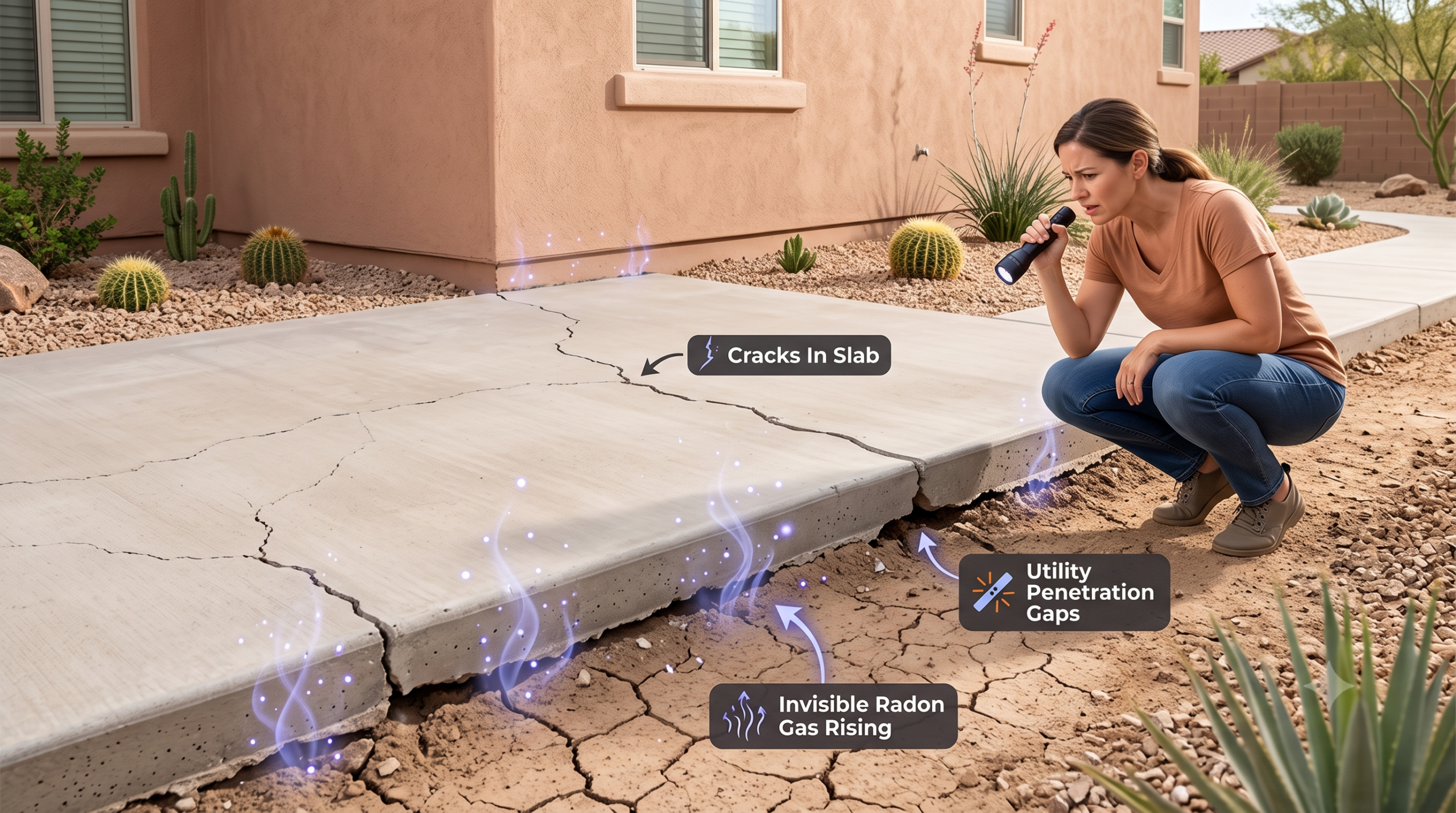
Quick answer: Yes. A home with no basement can still have radon, and in Arizona that is the norm, since more than 95 percent of homes sit on a concrete slab. Radon rises out of the soil and enters through cracks, joints, and plumbing gaps in that slab, so slab homes across the Valley can test above the EPA action level of 4 pCi/L just like basement homes do. The only way to know your number is to test.
Most people picture radon as a basement problem from the Midwest or the Northeast. That picture is one of the biggest reasons Valley homeowners skip testing. Almost nobody here has a basement, so folks assume they are in the clear. The truth is that a slab does not keep radon out. It is simply the surface the gas has to work through, and it has plenty of ways through.
Do slab homes really get radon?
They do, and Arizona is a slab state. According to state radon data, more than 95 percent of Arizona homes are built on a slab floor, most without a sump or a French drain. Radon is a colorless, odorless gas produced as uranium breaks down in the soil, and our desert ground has plenty of it. When that gas reaches the underside of your slab, the slightly lower air pressure inside your home can pull it up through any opening it can find. A poured slab is never perfectly sealed, so a home with no basement is still very much in play.
How does radon get into a slab home?
Radon does not need a big gap. Hairline openings are enough over time, and Arizona homes tend to develop them because our soil shrinks and swells with moisture. Common entry points include:
- Slab cracks. Settling and expansive clay soil crack concrete over the years, opening fresh paths for soil gas.
- Control and expansion joints. The seams where the slab meets a wall or another pour are natural channels for radon.
- Plumbing and utility penetrations. Every pipe, drain, and conduit that comes up through the slab leaves a gap around it.
- The perimeter edge. Where the slab meets the foundation wall, small voids let gas migrate in.
- Sub slab return air ducts. Some older Valley homes run heating and cooling ducts under the slab. When the fan runs, it can create a vacuum that pulls radon laden soil gas straight into the living space.
Why the no basement myth is so common here
The myth sticks because radon education was written for the rest of the country. National guides show a radon system snaking up out of a basement, and Valley buyers reasonably think that has nothing to do with their single story slab home in Peoria or Goodyear. Add the dry desert climate and it is easy to assume radon lives somewhere colder and wetter. In reality, elevated radon has been recorded in homes in every part of Arizona, from newer subdivisions to long established neighborhoods. A slab foundation and a sunny climate do not lower your risk. Only a test tells you where you stand.
How common is radon in Phoenix area slab homes?
Arizona has tracked radon results since 1993, and the data is a useful reality check for slab homeowners.
| Arizona radon fact | What it means for you |
|---|---|
| Average reading of 2.9 pCi/L | The typical Arizona home sits just under the action level, not at zero. |
| 26 percent of homes test above 4.0 pCi/L | Roughly one in four homes crosses the line where the EPA recommends action. |
| Highest recorded reading of 55.8 pCi/L | Some slab homes test many times over the limit. |
| EPA action level of 4 pCi/L | The EPA also suggests considering a fix between 2 and 4 pCi/L. |
You can read more about local patterns in our guide to whether radon is common in Phoenix and what a pCi/L reading actually means.
How do you test and fix radon in a slab home?
Testing is simple and does not care whether you have a basement. A short term test placed in the lowest lived in level of your home for a few days can give you a first reading, and a longer test gives a truer year round picture. If you are buying or selling, a professional radon test creates documentation both sides can trust. When a slab home tests high, the fix is a proven method called sub slab depressurization. A pipe is set through the slab, sealed, and connected to a quiet fan that pulls soil gas from under the foundation and vents it above the roofline before it can enter. Sealing visible cracks and joints supports the system, though sealing alone is rarely enough on its own. Our team can walk your home and explain a mitigation plan that fits your slab.
Frequently Asked Questions
Can a single story home on a slab have high radon?
Yes. Radon rises from the soil regardless of how many floors sit above it, and a single story slab home can test just as high as a two story house. The number of levels does not protect you. Only testing shows your actual reading.
Does the Arizona heat lower radon in my home?
No. The desert climate does not reduce radon, and running your air conditioning can actually pull more soil gas indoors in homes with sub slab ductwork. Elevated radon has been found across Arizona in every season. A test is the only way to know your level.
My slab looks solid, so do I still need to test?
Yes. Radon passes through openings far too small to see, including hairline cracks and the gaps around plumbing. A slab that looks perfect can still allow radon in. Testing is the only reliable check.
How much does it cost to test a slab home?
Arizona Radon gives a free estimate and quotes testing after we learn about your home, with transparent upfront pricing and no hidden fees. Costs vary with the size and layout of the house. You can request a quote or reach us through our contact page.
What happens if my slab home tests above 4 pCi/L?
A reading above 4 pCi/L means the EPA recommends taking action to reduce it. In a slab home that usually means a sub slab depressurization system with a fan. After installation, a follow up test confirms the levels have dropped.

Bio:
Kaber Robinson, a second-generation radon mitigator and the founder of Arizona Radon, has accumulated 30 years of experience in the industry. A nationally certified radon measurement and mitigation professional, Kaber’s commitment to health and environmental sustainability led him to the radon field after graduating from a renowned technical college in Kansas.
Gaining invaluable experience with a leading radon mitigation company in the United States, he traveled extensively to install systems across various environments. Today, Kaber applies his extensive knowledge and practical skills at Arizona Radon, where he ensures that each project adheres to the strictest standards of quality and safety.