




Do New Homes in Phoenix Need Radon Testing?
- Arizona Radon
- May 30th, 2026
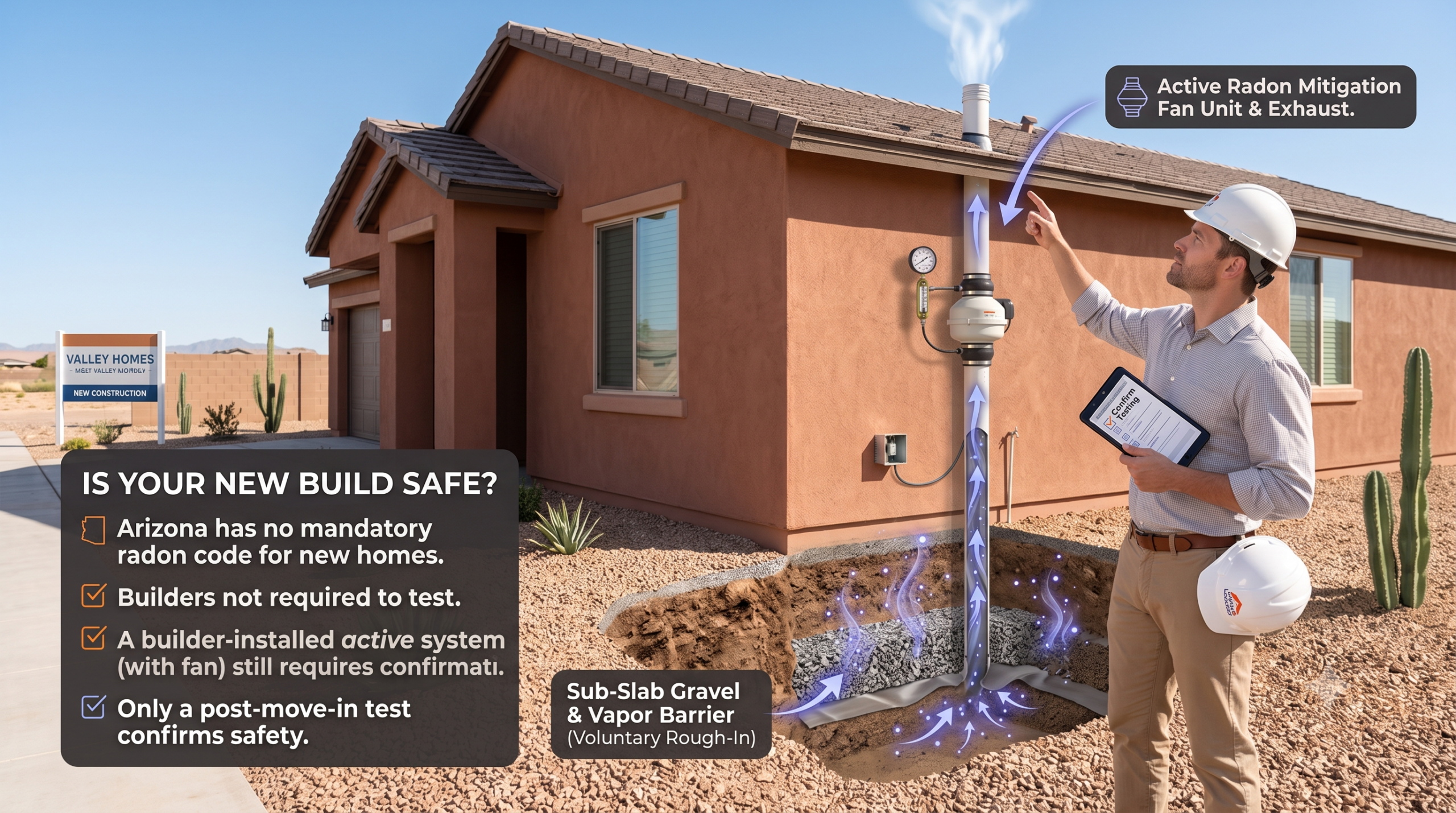
Quick answer: Yes. A brand new home can still have radon, because Arizona has no building code that requires radon resistant construction. Builders across the fast growing West Valley are not required to install a radon system or test the finished house, so the only way to know a new build is safe is to test it after you move in. The EPA recommends testing every home, new or old, and taking action above 4 pCi/L.
Buying new construction feels like buying peace of mind. Everything is fresh, sealed, and up to code, so radon is the last thing on most buyers minds. The problem is that radon comes from the ground, not from the age of the house. A new slab sits on the same uranium bearing desert soil as a home from the 1980s, and unless someone tested it, nobody knows what is coming up through that foundation.
Can a brand new home have radon?
Yes. Radon is a radioactive soil gas, and it enters a home through the foundation no matter how new that foundation is. A fresh slab can crack as the ground shifts, and gas still moves through control joints and around plumbing penetrations. In fact, a tightly built modern home can hold radon in, because it is sealed for energy efficiency and exchanges less air with the outside. New does not mean radon free. It just means the house has not been tested yet.
Does Arizona require radon resistant new construction?
No. According to the state radon program, no building codes in Arizona specifically require radon resistant construction features. Some builders add these features voluntarily or when a buyer asks, but it is not standard, and it is not mandatory anywhere in the Valley. That is different from states like Colorado, where certain counties require radon ready construction on every new home. Here, whether your builder prepares the home for radon is largely up to the builder. Always ask what, if anything, was installed.
What is a passive radon system in a new home?
When radon control is built in during construction, it usually starts as a passive system, meaning it works without a fan by using the natural rise of warm air in the vent pipe. A passive system can be upgraded to an active system later by adding a fan if testing shows levels are still high. A radon ready build typically includes:
- A gas permeable layer. A bed of clean gravel under the slab lets soil gas move freely toward the vent instead of into the home.
- Plastic sheeting. A sheet over the gravel and under the slab helps block gas from entering.
- Sealed openings. Cracks, joints, and penetrations are sealed to cut off entry paths.
- A vent pipe. A pipe runs from under the slab up through the roof to carry gas safely above the house.
- An electrical rough in. A junction box is set so a fan can be added quickly if a test later calls for it.
Here is how the two system types compare.
| Feature | Passive system | Active system |
|---|---|---|
| Fan | None, relies on natural airflow | Quiet continuous fan installed |
| Installed | During construction | During construction or added later |
| Best for | Lower readings, prevention | Homes that test above 4 pCi/L |
| Still needs testing | Yes | Yes, to confirm it works |
Why new construction matters in the West Valley right now
Few places in the country are building faster than the West Valley, which makes this a live issue for thousands of Valley families. Buckeye has grown to roughly 132,000 residents, up more than 40 percent since 2020, and ranks among the fastest growing cities in the nation. In a single recent year, Surprise added about 7,000 residents, Buckeye nearly 6,000, and Goodyear close to 5,900, with Queen Creek and Maricopa close behind. All of that is new slab construction on desert soil, and almost none of it is required to be tested for radon before move in. If you are closing on a new build in Buckeye, Surprise, Goodyear, or anywhere along the 303 corridor, a test is worth putting on your list. You can see the full service area we cover, including Peoria and the surrounding West Valley.
How and when should you test a new build?
The best time to test is after the home is finished and you are living in it under normal conditions, with doors and windows closed as they would be during a Valley summer. A short term radon test gives you a first reading in a few days, and it creates a documented baseline for a home that has never been checked. If your builder installed a passive system, testing is the only way to confirm it is actually holding radon below 4 pCi/L. If the reading comes back high, a fan can be added to an existing vent pipe, or a full mitigation system can be installed, and ongoing monitoring keeps an eye on the number over time. Building radon control in is almost always cheaper than retrofitting later, which is why testing early pays off.
Frequently Asked Questions
Do Arizona builders test new homes for radon?
Usually not, unless you request it. Arizona has no code requiring radon testing or radon resistant construction on new homes, so most builders do not test by default. Ask your builder directly, and plan to test after move in either way.
If my new home has a passive radon system, am I protected?
A passive system helps, but it is not a guarantee on its own. The EPA recommends testing every home, including those built with radon resistant features, because a passive system may not lower levels enough. Testing confirms whether a fan needs to be added.
When is the best time to test a newly built home?
Test once the home is complete and you are living in it with doors and windows closed under normal conditions. This gives the most realistic reading. A short term test can give a first result in a few days.
Is it cheaper to handle radon during construction?
Generally yes. Adding a vent pipe and gravel layer during the build is far less disruptive than cutting into a finished slab later. If you are still in the building process, it is worth asking your builder about a radon rough in.
How do I get a new build tested?
Arizona Radon offers a free estimate and transparent upfront pricing with no hidden fees. We test new construction across Phoenix and the West Valley and explain your results in plain terms. Request a quote to get started.

Bio:
Kaber Robinson, a second-generation radon mitigator and the founder of Arizona Radon, has accumulated 30 years of experience in the industry. A nationally certified radon measurement and mitigation professional, Kaber’s commitment to health and environmental sustainability led him to the radon field after graduating from a renowned technical college in Kansas.
Gaining invaluable experience with a leading radon mitigation company in the United States, he traveled extensively to install systems across various environments. Today, Kaber applies his extensive knowledge and practical skills at Arizona Radon, where he ensures that each project adheres to the strictest standards of quality and safety.